Recently, we were given instructions on how to use Excel for transferring data from an existing database to Excel spreadsheets. The Power point presentation used by the presenter had sound effects and graphics that included arrows, drum rolls and applause. I found it very helpful, especially when dealing with tiny boxes, letters and numbers. People were engaged in learning some new applications and the added humor broke the monotony nicely.
One of the most important things to know is that Power point is only a tool, which should be used as such to deliver the message intended by the person creating it.
Saturday, March 21, 2009

Saturday, March 14, 2009
ESL
My first question involving ESL was, "What is Literacy Volunteers?" I was given a brief answer by the desk attendant at the local YMCA, where I had been going to work out. "They need a new director, if you're interested", she said. "What would I have to do to apply?" I asked. "Just fill out the application form and send your resume. You can start on Monday", was the surprising answer. Little did I know what an adventure I was about to take. It was around the time of 9-11 -00, when every person of Arab descent was suspected to be a terrorist, that my first student, Mohammed, a native of Bangladesh ,with very little English, came to the office of Literacy Volunteers, seeking English language instruction. My attempt to teach him was rather intuitive and not at all orthodox, but he was able to learn quickly. Everything I did as Director was done by trial and error. Only a few people helped me, and it was very difficult . Some of the prospective students were from the U.S., with difficulties learning to read. We had to train tutors to be able to function as a volunteer organization. Therefore, I needed to be trained as a trainer. I took an online course to achieve this, and learned by doing. There was a database installed on the literacy office computer for tracking thr pairs of student-tutors who worked on learning English as a second language or on basic skills, such as writing a check. I had to meet with a Board of Directors, mail requests for donations, promote our organization, and at the same time, support the tutors and students through meetings, phone calls and assessments. Now when I look back, it was an incredible learning experience with next-to-nothing in financial rewards, but enormous benefits in terms of character-buliding, use of new technology and networking. I learned what it means to run a non-profit organization with little or no assistance. Plus, I discovered many things about myself and about the world. It was the quintessential "inquiry-based learning experience". Now I understand what English as a Second Language (ESL) means!
Monday, March 9, 2009
Power Point
After reading about differing views about Power Point in Education, I have decided that Power Point can be used creatively to do great things. On the other hand, it can be used lazily to block high level thinking. Some ideas for Power Point for ELL's are really useful because of the user-friendly format it offers them. They can produce language in a way that is non-threatening and that gives instant results that are impressive. The consistency of Power Point is comforting and lowers the affective filter. Adding sound and animation can also be interesting. We have all experienced mind-numbing Power Point presentations, read by the presenter, with very minimal imagination. This is similar to "Web Sites That Suck" - something to avoid.
Saturday, February 28, 2009
Reflections
Starting out in this course as a novice ( a rookie, a beginner ) makes it easy for me to be impressed and enthralled with all the incredible ideas for teaching via technology that are being presented in this class. I read the article, "Pay Attention" today and agree that we have to "engage, not enrage "students by meeting them where they're at: using ipods and cell phones, which are their constant companions. I do wonder why teachers cling to the old, though, rather than recognizing that texting is reading and writing and that students are bored by the traditional classroom approach.
From the very first day, with digital "tableaux", this has been a stimulating, inspiring experience - as we have been exposed to Photoshop and manipulating digital photos, reading about integrating and implementing technology, great examples for using blogging in "Teddy Bears Go Blogging, the use of Standards as we prepare our lessons, the issues about copyright law when using other people's material, the principles of Universal Design, using drama and knowing our students, I feel we have been provided with an enlightened background necessary for using technology in the classroom. It makes sense to learn about something before going out to teach students; this background knowledge is invaluable information.
From the very first day, with digital "tableaux", this has been a stimulating, inspiring experience - as we have been exposed to Photoshop and manipulating digital photos, reading about integrating and implementing technology, great examples for using blogging in "Teddy Bears Go Blogging, the use of Standards as we prepare our lessons, the issues about copyright law when using other people's material, the principles of Universal Design, using drama and knowing our students, I feel we have been provided with an enlightened background necessary for using technology in the classroom. It makes sense to learn about something before going out to teach students; this background knowledge is invaluable information.
Sunday, February 22, 2009
"Added Value"
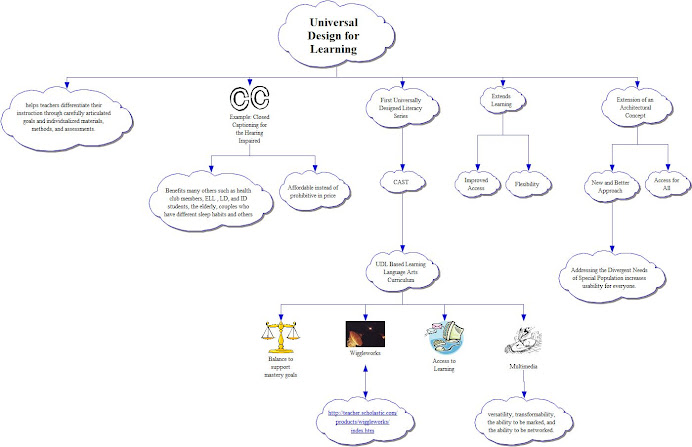
The techniques we have been learning about this semester in MD 400 definitely have "added Value" in that they offer ways to do things that would not otherwise be possible. Sharing here in this blog is one example of how to expand the potential forum to include anyone who has a computer, rather than restricting access to just the professor, or a few people in a class. This absolutely goes along with the idea of Universal Design for Learning because it is more easily accessible. Some of the components embedded in our digital imagery manipulation for the website we are working on - such as naming our saved images (using alternate text) so that they may be understood by the visually impaired using voice technology in place of read only also broaden the horizons for sharing information with people of all learning styles.
Monday, February 16, 2009
Student Standards
Since I work with all levels of ESL students, my choice of standards for them is taken from the National TESOL standards:
"Goal 3, Standard 3 -To use English in socially and culturally appropriate ways: Students will use appropriate learning strategies to extend their sociolinguistic and sociocultural competence."
This includes using technology, of course, which expands the potential for learning tremendously. My concerns ( and those of my colleagues ) are for students to reach proficiency and to score well on the standardized tests they are required to take at school. This places demands on them to master all the aspects of language that come naturally to a native speaker of English. ELL's need intense, explicit instruction of things like idioms because they have not been exposed to all of these non-literal forms of expression.
"Goal 3, Standard 3 -To use English in socially and culturally appropriate ways: Students will use appropriate learning strategies to extend their sociolinguistic and sociocultural competence."
This includes using technology, of course, which expands the potential for learning tremendously. My concerns ( and those of my colleagues ) are for students to reach proficiency and to score well on the standardized tests they are required to take at school. This places demands on them to master all the aspects of language that come naturally to a native speaker of English. ELL's need intense, explicit instruction of things like idioms because they have not been exposed to all of these non-literal forms of expression.
It is somehow satisfying to challenge the traditional classroom approach using the ubiquitous K-W-L charts to initiate lessons with asking HOW instead - and actually digging deep and wide to find the answers. Promoting this kind of investigative work is the way to find out about things, and it will revolutionize schools when implemented. As a team player, teaching in a school district, it is very difficult to introduce new ideas for teaching. Keeping one's job is part of the very real problem with the system. If enough of us push for open classrooms, we will see the results. Our world needs thinkers and doers who are seeking answers and are not afraid to look for them.
Subscribe to:
Posts (Atom)